How to Tell Whether a Recipe Gives Enough Detail
Learn how to assess recipe clarity before cooking, spot missing decisions and choose a useful alternative when instructions leave room for guesswork.
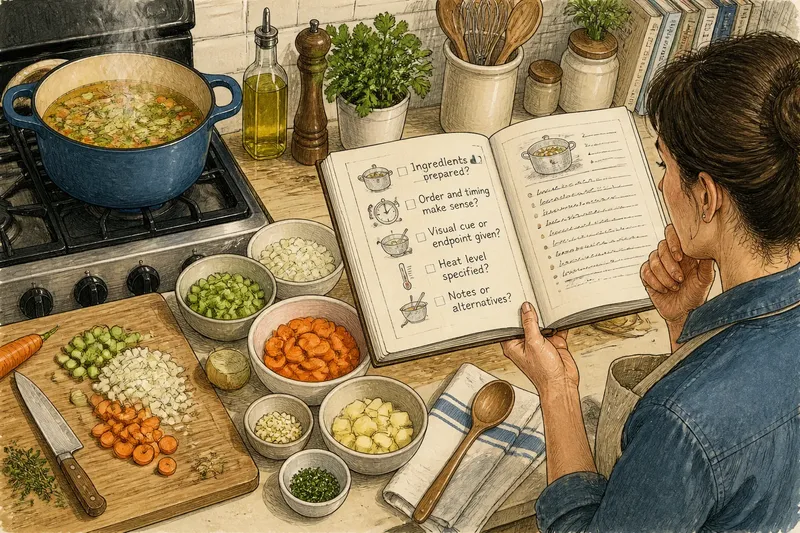
You set a chopping board beside the hob and notice that a recipe asks you to divide the vegetables among several bowls. Before reaching for more dishes, check whether the method explains what the separation is for. Recipe clarity is about whether the instructions let you make the necessary choices, not how many tasks they describe.
Recipe clarity in practice
A clear recipe names the action, the relevant condition and, where needed, the next decision. “Add the flour in two batches, mixing after each” gives a sequence; “mix until no dry flour remains” tells you what to look for before moving on.
Times can help organise a meal, but a time without context may leave you unsure what to do if the food looks different from the description. A recipe that says to simmer until the sauce thickens gives you an endpoint; an estimated time can help you plan around it.
Useful recipe details
Details earn their place when they resolve a choice that could change the dish. “Use softened butter” distinguishes it from butter taken straight from the fridge, while “drain the beans” clarifies what should go into the pot.
Repeated information can still help a new cook, but it should make the sequence easier to follow. A direction that repeats a quantity without explaining when to add it may add words without resolving a decision.
A recipe resembles a set of signposts on a walk: each one should help you choose a direction or recognise a turning point. Describing every footstep would obscure the route rather than clarify it.
Timing and sequence
Instructions are easier to use when they show how tasks fit together. A method might ask you to put water on to boil, prepare a sauce while it heats, then cook the pasta as the sauce finishes. It should still make clear what condition tells you each part is ready.
Read the method for dependencies: does one ingredient need to be ready before another starts cooking, or can two tasks happen at once? If the order affects the result, the recipe should make that order plain rather than leaving you to infer it from a crowded list.
For food that requires safe handling or cooking, follow appropriate food-safety guidance and the relevant product instructions. A recipe’s timing should not replace safety directions.
When extra steps help
An extra instruction is useful when it changes the result or makes a difficult choice clearer. Resting dough can give the flour time to absorb moisture; saving some pasta water gives you an option if the sauce needs loosening.
Separate stages can also explain how one action sets up the next. A method that browns meat, removes it, then softens vegetables in the same pan shows both the order and why the browned residue remains available for the sauce.
Say you are preparing a vegetable soup, and the recipe tells you to place each chopped carrot in its own bowl before adding all the carrots together. The starting point is one batch of carrots, with no different cooking times or treatments specified. You could keep the chopped carrots together on the board instead; the expected result is still one batch ready for the pot, while fewer dishes need washing. If the recipe later adds some carrots earlier than others, keep those groups separate because the timing changes the decision.
Assessing recipe clarity
- Check whether the ingredient list says “drained” or “rinsed” for tinned beans; if it does, prepare them that way, and if it does not but the method depends on liquid, check the recipe’s notes before deciding whether to include it.
- Check whether “softened butter” is defined or shown in the method; if it is, follow that condition, and if it is not, consult a dependable cooking reference rather than treating cold and softened butter as interchangeable.
- Check whether the oven setting is stated; if it is, use that setting, and if it is absent, look for the recipe’s source notes or choose a different recipe rather than guessing when the setting would affect the result.
- Check whether a cooking time has a visible endpoint, such as tender vegetables; if it does, use that cue alongside the time, and if it does not, see whether another instruction defines doneness before starting.
- Check whether ingredients are added in separate stages; if they are, prepare separate portions, and if they enter together and need no distinct treatment, group them during preparation.
- Check whether the method says when to lower or raise the heat; if it does, follow that change, and if it does not, use a recipe with clearer heat guidance when the heat level could alter the dish.
Short recipes and missing choices
A short method can be easy to follow when the ingredients are specified and the sequence leaves no important question unanswered. It becomes harder to use when a word such as “brown” has no further description and the colour matters to the next stage.
Before cooking, check whether the recipe gives the oven setting, the ingredients’ required state and the pan or cooking method when those details affect what happens. These checks are about finding information that changes your next action, not demanding extra prose for its own sake.
Longer methods can be just as clear if their extra words explain real choices: when to reduce the heat, what a thickened custard should look like, or what to do if a sauce becomes too thick. The useful question is whether each instruction helps you act or decide.
Questions about recipes?
What does “until done” mean?
Look for a cue such as tenderness, colour or thickness that fits the food being cooked. If the method gives no endpoint, check its notes or choose a recipe that explains how to recognise doneness.
Do ingredients need separate bowls?
Separate bowls help when ingredients go into the dish at different times or need different preparation. If several ingredients enter together and need no separate treatment, keep them together to make the sequence simpler.
Should I follow the time or the visual cue?
Use the stated time to plan and the recipe’s endpoint to judge the food, particularly if the method calls the time an estimate. If the two conflict and the result is unclear, pause and consult the recipe’s accompanying notes rather than forcing the food to match the clock.
What if an ingredient’s preparation is unclear?
Check the recipe’s ingredient list, notes and method for terms such as “packed,” “sifted,” “drained” or “room temperature.” If none explains the term and it could change the outcome, consult a reliable cooking reference or use a recipe that states the preparation plainly.
Reading before cooking
Before starting, mark the points where you will need to judge the food rather than simply follow an action: a sauce should thicken, dough should feel supple, or vegetables should retain some bite. Gathering the right equipment and preparing ingredients for those stages can make the method easier to follow.
For a first attempt, keep the recipe’s important distinctions intact, especially where they affect timing, texture or safe handling. Once you understand the sequence, you can see which directions support the result and which merely organise your movements.
Recipe clarity is a useful search phrase when you want to decide whether a method gives enough guidance before you begin. Look for instructions that resolve a real choice, and treat missing safety or equipment details as a reason to consult reliable guidance rather than guess.