Before the Refrigerator: How the Icebox Changed the Kitchen
Before the refrigerator, the household icebox brought blocks of stored ice into the kitchen and reshaped how families kept food cool and planned meals.
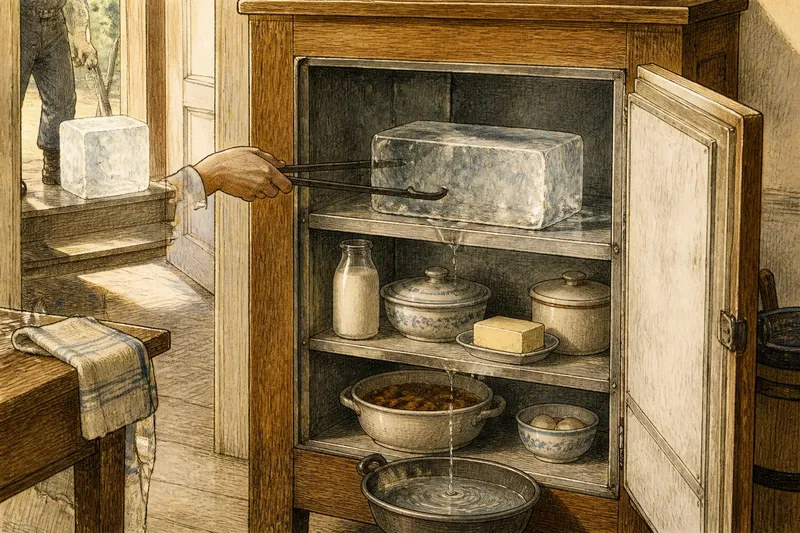
A deliveryman leaves a heavy block of ice on the back step, and someone carries it into the kitchen with tongs. Meltwater gathers in a pan beneath a wooden cabinet; inside, milk, butter and yesterday’s stew sit on shelves cooled by the ice above. The household icebox was not simply an early refrigerator. It was a piece of furniture organized around a perishable supply, and its place in the kitchen changed as that supply became part of domestic routine.
Ice before the icebox
People kept food cool long before the household icebox. Cellars, wells, shaded larders and springhouses offered cooler conditions than a warm kitchen, while salting, drying, smoking, pickling and preserving in sugar helped food last without refrigeration. These methods did different jobs: a cellar might slow spoilage, while salting altered the food itself.
Stored natural ice added another option. In cold regions, ice could be cut from frozen lakes or ponds, packed into insulated storage and kept for use in warmer weather. Sawdust, straw and other insulating materials slowed melting. The ice was valuable because it brought winter cold into another season, but it had to be gathered, stored and moved before it could cool food at home.
For many households, the difficulty was not imagining a cold cupboard but obtaining a dependable supply. Ice harvesting and commercial delivery expanded access in places where storage and transport made the trade workable. The icebox joined those larger arrangements to a daily domestic task: receiving ice, placing it in the cabinet and managing the water it left behind.
A cabinet built around ice
An icebox was commonly a cabinet with an insulated compartment for a block of ice and a separate space for food. Metal lining helped protect the cabinet’s interior, while shelves and dividers gave food distinct places. The arrangement used gravity and airflow: cold air moved down from the ice compartment, and meltwater drained toward a pan or outlet below.
Its materials and appearance varied. Some cabinets were plain and practical; others were finished as substantial kitchen furniture, made with wood outside and metal inside. The ice compartment could sit above the food chamber, making the cabinet taller and giving the ice a clear position in the design. The ice itself was a consumable part of the appliance, not a hidden mechanism.
That distinction shaped use. A refrigerator creates cold through a powered system; an icebox stores cold in a block that gradually melts. The cabinet could not work independently of its ice supply, and its cooling changed as the ice diminished. Like a teapot that needs refilling before it can serve another round, the box depended on a regular input from outside the kitchen.
Even the name kept the arrangement visible. “Icebox” described the material that made the cabinet useful, rather than a mechanical action. When a household spoke of getting ice, it meant a household task as ordinary and necessary as replenishing fuel or bringing in groceries.
Delivery enters the kitchen
As ice became a market commodity, the icebox connected the kitchen to a delivery network. Ice could arrive by wagon or cart, depending on place and period, and a household might order a block suited to the cabinet and its needs. A card or sign displayed near the entrance could communicate a request to the delivery worker, keeping the exchange brief and practical.
That arrangement shifted part of food keeping beyond the home. The household still had to store food sensibly, clean the cabinet and watch the meltwater, but it no longer needed to harvest and preserve every block itself. Ice companies, storage depots and transport routes made the cabinet useful to people without a private icehouse.
Access remained uneven. A household needed a suitable cabinet, a supplier serving its neighbourhood and enough room to manage the block and the drainage. Delivery could be routine in one district and inconvenient in another. The icebox therefore tells a story not only about domestic invention but also about streets, commerce and the uneven reach of urban services.
Imagine a household receiving a block on a warm morning. Someone lifts it into the ice compartment, sets the drip pan beneath its drain and moves a covered bowl of leftovers onto a lower shelf. The expected result is a cabinet that cools the food while the melting ice collects in the pan; the household must still empty that pan and arrange another delivery as the block dwindles.
Daily habits and food placement
The icebox asked users to think spatially. Food nearer the cold source might stay cooler than food farther away, so shelf placement mattered. Milk, butter, cooked dishes and other perishables could be kept inside, while dry goods remained in a pantry. The cabinet offered a cool zone, not a uniform climate for every ingredient.
Containers also mattered. Covered dishes helped keep food apart and reduced the chance that spills or odours would travel between shelves. A cook might cool a pot before storing it rather than placing a steaming vessel directly into the cabinet. Such habits were shaped by the limited, changing supply of cold and by the need to leave room for the next block.
Because ice melted, its management was part of kitchen housekeeping. A user had to check the drain and pan, wipe moisture, and keep the interior clean. Neglected water could become a nuisance, so the icebox joined food storage to a recurring chore. It was not a sealed, effortless refuge from spoilage; it asked for attention in exchange for a cooler place to keep food.
The cabinet also influenced when people shopped and cooked. A household might buy perishable food with the available cooling space in mind, use delicate items sooner, and rely on preserved foods when the ice supply was uncertain. These decisions varied with climate, household size, income and local markets. There was no single icebox routine that fitted every kitchen.
Kitchen status and placement
As a large, frequently used object, the icebox affected the room around it. Its size, weight and need for a drain or drip pan shaped where it could stand. A convenient position near the kitchen’s work area made it easier to fetch ingredients, but access for delivery and cleaning also mattered. Unlike a small storage jar, the cabinet claimed a lasting place.
In some homes, the icebox was kept in a kitchen or pantry; in others, household arrangements put it in a less prominent service area. The choice reflected room layout and the division of domestic labour as much as taste. Whoever handled deliveries and emptied the pan had to reach the cabinet regularly, making its location a practical decision.
Its visible materials carried social meaning, too. A finished wooden exterior could make an appliance look like furniture, while its metal interior signalled a surface intended for repeated cleaning. Yet a polished cabinet did not remove the work behind it. The household’s access to ice, time for upkeep and knowledge of food handling remained essential to how useful the object was.
The electric change
Electric refrigeration altered the relationship between cabinet and cold. Instead of receiving a block and allowing it to melt, a refrigerator made cold through a powered cooling system. As such appliances became more available and dependable for households, the icebox lost its central role in food storage. The transition was gradual rather than identical everywhere: cost, electricity access, housing and local delivery shaped the timing.
The change involved more than replacing one cabinet with another. The icebox made the arrival of cold visible, and its supply could be tracked by looking at the remaining block. Mechanical refrigeration moved that work out of view, but it introduced other considerations, including power and a different kind of appliance maintenance. Household habits adjusted around a new source of cold.
Some iceboxes were repurposed or discarded, while others remained as reminders of an older kitchen routine. Their design makes a useful historical point: household technologies often depend on systems beyond the room where they are used. The cabinet could sit beside the table, but its usefulness was connected to ice harvesting, storage, transport, delivery and the labour of upkeep.
Questions about iceboxes?
How did an icebox keep food cool?
A block of ice sat in an insulated compartment, often above the food chamber. As it melted, cold air moved through the cabinet and meltwater drained toward a pan or outlet, so cooling weakened as the ice was used up.
Where did household ice come from?
Some ice was cut from frozen lakes or ponds and stored under insulating materials for later use. In many towns, commercial suppliers moved ice through storage and delivery networks, bringing blocks to households that had a suitable cabinet.
Was an icebox the same as a refrigerator?
Both provided a cool place for food, but an icebox depended on a stored block of ice, while a refrigerator used a mechanical cooling system. The difference changed the household routine: one required ice deliveries and drainage care, while the other relied on power and appliance maintenance.
What happened to iceboxes after electric refrigeration spread?
As electric refrigerators became accessible, households increasingly replaced iceboxes with powered appliances. The shift took place at different times in different settings, and surviving iceboxes can still be recognised by their insulated cabinets, ice compartments and drainage arrangements.
Reading the old routine
The history of the icebox is most legible in its practical details: a block to order, a cabinet to place, shelves to arrange and water to remove. Those chores explain why the object mattered beyond its shape. It reorganised food keeping around a delivered material and made the kitchen part of a wider chain of supply.
Before the refrigerator, the icebox offered households a way to bring stored ice into everyday cooking and food care. Its story is not simply a march from old to new technology. It shows how a domestic object can alter habits while remaining dependent on the people, services and routines that keep it working.
When you see an old icebox, look for the relationship between its compartments: the place for ice, the shelves for food and the route for meltwater. Those features reveal the most useful point about the icebox’s place in kitchen history: cold was not yet an invisible service, but a material that arrived, occupied space and had to be managed.